Chủ Nhật, 29 tháng 7, 2007

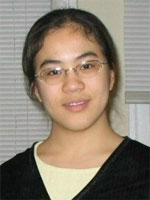
Sherry Gong- A super girl


Sherry Gong
Phillips Exeter Academy, Exeter, NH
Junior
Hobbies
My hobbies include reading (anything I can, whenever I have time), memorizing poems, Chung Do Kwan (which I started this year and will not be able to continue)

Clubs
At school I participate in Physics Club, and will be captain of the Math Club next year.

Experience
International Math Olympiad (seventh grade; bronze medal in eighth grade (2003); silver medal in ninth and tenth grade (2004, 2005)); USA IMO team 2005, USA Math Olympiad (honorable mention in 2003, participated in 2004, winners in 2005 and 2006,), Olimpiada Iberoamericana de Matemáticas (For Spain, Portugal and Latin America) (2003, gold medal), Math Olympiads of Central America (silver medals in both sixth grade (2001) and seventh grade (2002)), National Geography Bee in seventh grade (2002) island championship and twelfth place nationally

Biography
I was born in Long Island, NY in July, 1989 and moved to Canada when I was two. When I was six, I moved to Chicago, and then to Puerto Rico, where I currently reside (although I go to a boarding school in New Hampshire). In the area of competitions, I took the IMO on the Puerto Rican team three times and on the US team once. I also attended the US Math Olympiad Program (MOP) in 2003, 2004, and 2005. In middle school, I participated in National Geography Bee. I would like to thank Mr. Henner, Mr. Zhang, Mr. Saltman, Ms. Waterman, Mr. DiCarlo, Dong Fang Hu, as well as my parents and classmates for their support and for helping me get this far in physics. My favorite color is blue, I preferred pink in elementary school and purple in middle school. I like walking on mountainous areas, especially in tropical rain forests. Some of my favorite books are Lord of the Rings, Othello (which I find to be the best Shakespeare play by far), The Unvanquished (Faulkner), and Ender's Game. In middle school I actually believed in Tolkien’s tales of Middle Earth (which isn't to say that I don't anymore). Some of my favorite poems are Fire and Ice, The Raven and Annabel Lee and everything else written by Poe, Namarie (Galadriel's Lament), and the 15th poem of “Veinte Poemas de Amor y una Cancion Desesperada”. I took Go Ju Ryu for about half a year before I started attending Exeter. At MOP 2004 the girls were on the eleventh floor and I used the elevator a total of twice (once on the first day, once on the last). I learned how to knit three times. Unfortunately, I also forgot how to do it three times.

Sherry won a silver medal at the 2005 IMO in Merida, Mexico for the US Team. She competed at the IMO in 2004 for Puerto Rico and received a silver medal. She placed 12th nationally in the Geography Bee in 2002 and was a member of the 2005 and 2006 USA Physics Olympiad Team receiving a silver medal in last year's competition. She was designated the Clay Mathematics Institute Olympiad Scholar in 2005. She likes computer programming, geography and enjoys reading. She credits her Dad, Professor Li and Dr. Zuming Feng for influencing her interest in mathematics and in pursuing her live of competition. She will be attending Harvard University in the fall.

U.S. Physics Team Wins Golds/Silver

2006 U.S. Physics Team Medalists. (From left to right): Otis Chodosh (Gold), Sherry Gong (Silver), William Throwe (Gold), Menyoung Lee (Gold), Henry Tung (Gold)
College Park, MD (July 16, 2006) - Every U.S. student sent to the 2006 International Physics Olympiad held this year in Nanyang University in Singapore, will bring home a medal, and four of those are gold.

Menyoung Lee, a senior at Thomas Jefferson High School for Science and Technology, Alexandria, VA, won a gold medal for the second year in a row. The other gold medalists are: William Throwe, a senior at Shoreham-Wading River High School, Shoreham, NY. Last year Throwe served as an alternate to the team. Henry Tung, a junior at Torrey Pines High School in San Diego. Otis A Chodosh, a senior at the Oklahoma School of Science and Mathematics in Oklahoma City. Bringing home a silver medal: Sherry Gong, a junior at Phillips Exeter Academy in Exeter, NH.

The U.S. team met with great success, head coach Robert Shurtz said. In an unofficial ranking of countries based on total score of the five team members, the United States ranked second. Chinas students had the highest overall total scores. This was largest International Physics Olympiad to date with 86 nations participating with a total of 383 competitors. Last year, the team brought home two golds, two silvers and a bronze medal.

Shurtz, a physics teacher at the Hawkens School in Gates Mills, OH, and assistant coach Paul Stanley, a physics and astronomy associate professor at Beloit College in Wisconsin, accompanied the team to the nine-day competition.

The U.S. Physics Olympiad Program was started in 1986 to promote and demonstrate academic excellence and prepare students to compete in the International Physics Olympiad. The U.S. Physics Team is co-sponsored by the American Association of Physics Teachers and the American Institute of Physics.

Sherry Gong named Clay Olympiad Scholar, June 27, 2005

Jim Carlson, Guhua Gong,Sherry Gong,Liangqing Li


Miss Sherry Gong, a 10th grade student at Phillips Exeter Academy, was named the 2005 Clay Olympiad Scholar at a ceremony in Washington DC on June 27, 2005.

The Clay Olympiad Scholar Award recognizes the most original solution to a problem on the US American Mathematics Olympiad (USAMO). It consists of a commemorative plaque and cash award to the recipient, and a cash award to the recipients' school. The award is presented each year at the official awards dinnner for the USAMO held in June in Washington, DC at the State Department Ballroom.

Sherry Gong, daughter of Guhua Gong and Liangqing Li of San Juan, Puerto Rico, attended schools in Puerto Rico until this last year when she enrolled at Phillps Exeter Academy in Exeter, New Hampshire. Sherry attended a mathematics olympiad for the first time when she was in the sixth grade — the 3rd Olympiada Matematica de Centroamerica y el Caribe. There Sherry received a silver medal and also a special award for the most original solution. It was the first such award in the history of this olympiad. Sherry received a silver medal the next year at the same olympiad, and in 2003 she received a gold medal at the XVIII Olympiada Iberoamericana de Matematicas. She also received a bronze medal in the 44th IMO (2003) and and a silver medal in the 45th IMO (2004).

In addition to mathematics, Sherry is interested in physics and computer programming. She won a position in the 24-member USA Physics Olympiad Team (2005). She enjoys seeing the connection between physics and mathematics, and she likes to find her own solutions when given a math or physics problem.

Sherry won the State Championship for the Geo Bee and represented Puerto Rico in the National Geo Bee in Washington DC (2002). She also likes karate, poetry and reading.


U.S.A. International Mathematical Olympiad 2005 Team


Standing, from left to right: Joseph A. Gallian, Eric Larson, Krishanu Sankar, Sergei Bernstein, Adam Hesterberg, Delong Meng, Jacob Steinhardt, Sherry Gong.
Kneeling: Tedrick Leung, Alex Zhai, Arnav Tripathy, Brian Lawrence, Haitao Mao.

Sherry Gong is a 12th grader at the Phillips Exeter Academy in Exeter, N.H. Sherry tied for second in this year's competition and won a $15,000 scholarship from the Akamai Foundation.

olympiad2005remarks from claymath.org
It is a great honor to be here this evening
with so many talented young people from
across the United States. You are here
tonight because of your ability, interest, and
achievement in mathematics. On behalf of
the Clay Mathematics Institute, of its
founder, Landon Clay, and of his wife and
fellow director, Lavinia Clay, I congratulate
each of you.
My role tonight is to present the Clay
Olympiad Scholar Award, which recognizes
the most original solution to an Olympiad
contest problem. In a few minutes I will
announce the winner. But first, some brief
comments.
Most contests, whether they be in athletics
or mathematics, place a premium on
strength and speed. These are important
qualities, qualities to be admired. But there
is another quality that is perhaps of still
greater value: originality. My dictionary
defines originality as
the ability to think creatively or
independently: a writer of great
originality
the quality of being novel or unusual: he
congratulated her on the originality of her
costume
Originality is not likely the quality that the
layman immediately associates with
mathematics, or with science more
generally. But originality is *the* quality
which drives knowledge forward, which
opens up new frontiers. And it is therefore
the highest accolade that we can give.
Consider for a moment the case of Albert
Einstein, whose centenary we celebrate this
year. At no time in his career -- as a high
school student, as an employee of the Swiss
patent office, as a renowned physicist -- did
Einstein dazzle by the speed of his problem
solving abilities. Rather it was the depth and
originality of his ideas that made the
difference. And what a difference it made!
He gave us the special and general theories
of relativity, and with them keys to
understanding light, subatomic particles,
black holes, and the big bang. He played a
key role in the development of quantum
theory, even though he never really
"believed" in it.
To repeat, it was originality that made the
difference for Einstein. And it was
originality that has always made the
difference in the work the greatest
mathematicians, such as Archimedes, or
Riemann.
Now has come the time to speak aobut this
year's awardee, Miss Sherry Gong. Until
last year, Sherry attended school in San
Juan, Puerto Rico, where her parents are
professors of mathematics at the University
of Puerto Rico. Sherry attended a
mathematics olympiad for the first time
when she was in the sixth grade. This was
the 3rd Olympiada Matematica de
Centroamerica y el Caribe. There Sherry
received a silver medal and also a special
award for the most original solution. It was
the first such award in the history of this
olympiad. Sherry received a silver medal the
next year at the same olympiad, and in 2003
she received a gold medal at the XVIII
Olympiada Iberoamericana de Matematicas.
She also received a bronze medal in the 44th
IMO (2003) and and a silver medal in the
45th IMO (2004).
This past year, Sherry has been a student at
Phillips Exeter Academy, in Exeter, New
Hampshire.
Besides mathematics, Sherry likes physics.
She won a position in the 24-member USA
Physics Olympiad Team (2005). She enjoys
seeing the connection between physics and
mathematics, and she likes to find her own
solutions when given a math or physics
problem.
Sherry also likes Geography. She was the
State Championship for the Geo Bee and
represented Puerto Rico in the National Geo
Bee in Washington DC (2002). Besides
math and science, Sherry likes computer
programing, karate, poetry and reading.
It is a great pleasure to present the Clay
Olympiad Scholar Award to Sherry Gong.
She will receive a commemorative plaque
and a check to help with her education. Her
school, Phillips Exeter Academy, will also
receive a check to recognize its role in
Sherry's success.
On behalf of the Clay Mathematics Institute,
its Scientific Advisory Board, and its Board
of Directors, I congratulate Sherry; her
parents, Professors Guhua Gong and
Liangqing Li; her school in Puerto Rico,
Phillips Exeter Academy, and Sherry's
teachers.

Sherry Gong, Phillips Exeter Academy
IMO Silver Medalist (2004, 2005)
IMO Bronze Medalist (2003)
IMO Honorable Mention (2002)
US IMO Team member (2005)
Puerto Rican IMO Team member (2002 - 2004)
USAMO Winner (2005)
MOSP member (2003 - 2005)


Checking out a statue: Sherry Gong & Ameya Velingker

Sherry Gong '07 Joins US Physics Olympiad Team
College Park, MD (May 28, 2006)— Sherry Gong '07 was one of five students selected today to represent the US at the 2006 International Physics Olympiad, a competition among high-school physics students, to be held this year in July at the National Institute of Education, Nanyang Technological University, Singapore. Teams from 85 countries will compete, the most that have ever participated.

In May, 24 top US physics students attended a nine-day training camp at The University of Maryland, where, through classes, labs and special lectures, they were coached on difficult physics concepts before taking a final, qualifying exam. They also made a trip to nearby Washington, DC, to meet personally with their state senators and representatives in the US Congress and House of Representatives. The American Association of Physics Teachers (AAPT,) a non-profit organization based in College Park, MD, co-sponsored these activities.

Last year at the international competition held in Salamanca, Spain, the U.S. team brought home two golds, two silvers and a bronze medal.

The US Physics Olympiad Program was started in 1986 by AAPT to promote and demonstrate academic excellence. The Olympiad is a nine-day international competition among pre-university students from more than 80 nations.

2006 US Physics Team
Sunday, July 16, 2006

College Park, MD (July 16, 2006) - Every U.S. student sent to the 2006 International Physics Olympiad held this year in Nanyang University in Singapore, will bring home a medal, and four of those are gold.

Menyoung Lee, a senior at Thomas Jefferson High School for Science and Technology, Alexandria, VA won a gold medal for the second year in a row.

The other gold medalists are: William Throwe, a senior at Shoreham-Wading River High School, Shoreham, NY. Last year Throwe served as an alternate to the team. Henry Tung, a junior at Torrey Pines High School in San Diego. Otis A Chodosh, a senior at the Oklahoma School of Science and Mathematics in Oklahoma City.

Bringing home a silver medal: Sherry Gong, a junior at Phillips Exeter Academy in Exeter, NH.

“The US team met with great success,” head coach Robert Shurtz said. “In an unofficial ranking of countries based on total score of the five team members, the US ranked second.” China’s students had the highest overall total scores.” This was largest International Physics Olympiad to date with 86 nations participating with a total of 383 competitors. Last year, the team brought home two golds, two silvers and a bronze medal. He also noted that the traveling team met on June 30th at Cal Poly - Pomona for four days of laboratory work as the final step in preparing for the international competition. We were all grateful to be hosted once again by Mary Mogge, former academic director of the US Physics Team and chair of the physics department at Cal Poly. We had a very successful and enjoyable mini-camp as a result of the hospitality and helpfulness of Mary and the staff of the physics department. We flew on July 4th for Singapore. We had two days to adjust to the twelve hour time difference and explore Singapore before the competition officially began on July 8th. This was a very hard working and a very fun group of five students to work with. I'm extremely excited and proud of their accomplishments. Four golds and one silver and second place overall makes this one of the best showings of the US Physics Team at any IPhO. I'll greatly miss working with this talented, cohesive, dedicated, and humorous group of students.


Sherry Gong receives a silver medal at this year's 37th annual physics competition in Singapore
Sherry Gong '07 Awarded Silver Medal at International Physics Competition


Sherry Gong receives a silver medal at this year's 37th annual physics competition in Singapore


Sherry Gong ’07 earned a silver medal at this year’s 2006 International Physics Olympiad, the first international physics award to be awarded by an Exeter student since 1999. The Olympiad is a worldwide competition among high-school physics students, held last month at the National Institute of Education, Nanyang Technological University in Singapore. She was among five 2006 U.S. physics team members, four of whom earned gold medals.

Physics instructor Scott Saltman said Sherry’s passion and commitment to working hard have resulted in her accomplishments. “Sherry is passionate about physics. Her achievement in this competition is a tribute to her hard work and her tremendous insight. It's a great honor for the Academy to have a student reach this prestigious level,” he said.

The other team players were awarded gold medals. Menyoung Lee, a senior at Thomas Jefferson High School for Science and Technology, Alexandria, VA, who won a gold medal for the second year in a row; William Throwe, a senior at Shoreham-Wading River High School, Shoreham, NY; Henry Tung, a junior at Torrey Pines High School in San Diego; and Otis A Chodosh, a senior at the Oklahoma School of Science and Mathematics in Oklahoma City.

Team head coach Robert Shurtz said the U.S. team met with great success, earning an unofficial ranking of second. Countries were judged based on a total score of the five-team members. Chinas’ students came in first with the highest overall total scores. This was largest International Physics Olympiad to date with 86 nations participating with 383 competitors. Last year at the international competition held in Salamanca, Spain, the U.S. team brought home two gold, two silver and a bronze medal.

In May, 24 top US physics students attended a nine-day training camp at The University of Maryland, where, through classes, labs and special lectures, they were coached on difficult physics concepts before taking a final, qualifying exam. They also made a trip to nearby Washington, DC, to meet personally with their state senators and representatives in the US Congress and House of Representatives.


The 2006 U.S. physics traveling team
The American Association of Physics Teachers (AAPT,) a non-profit organization based in College Park, MD, co-sponsored these activities. The U.S. Physics Olympiad Program was started in 1986 to promote and demonstrate academic excellence and prepare students to compete in the International Physics Olympiad. The U.S. Physics Team is co-sponsored by the American Association of Physics Teachers and the American Institute of Physics.

http://www.agnesscott.edu/lriddle/women/women.htm
Association for Women in Mathematics
Essay Contests Association for Women in Mathematics


USAMO Winners Sherry Gong and David Lawrence, with Prof. Gregory Galperin


Brian Lawrence and Sherry Gong.


Waiting for the Lecture (given at the State Department) to begin: from right: Krishanu Sankar, Eric Larson, Tedrick Leung, Sergei Bernstein, Arnav Tripathy, Adam Hesterberg, Brian Lawrence and Sherry Gong.


Standing, from left to right: Joseph A. Gallian, Eric Larson, Krishanu Sankar, Sergei Bernstein, Adam Hesterberg, Delong Meng, Jacob Steinhardt, Sherry Gong.
Kneeling: Tedrick Leung, Alex Zhai, Arnav Tripathy, Brian Lawrence, Haitao Mao.


After visiting the Cryptologic Museum the group of winners and their families had a Picnic on the Lawn in front of the building.


USAMO Medals, before presentation.


Standing, from left to right: Adam Hesterberg, Krishanu Sankar, Brian Lawrence, Sergei Bernstein, Eric Larson, Delong Meng, Jacob Steinhardt.
Front: Sherry Gong, Haitao Mao, Alex Zhai, Arnav Tripathy, Tedrick Leung.


The group receiving the Robert P. Balles USAMO Winners Awards.


Balles Awards


Balles Awards


Getting Ready to take the Team Tests.


Sherry Gong, Alex Zhai and DeLong Meng

2007 USAMO Ceremonies
family of Tedrick Leung took photos

USAMO 2006


AMC Director Steven Dunbar took these photos

Washington, D.C. Ceremonies for the Winners of the United States of 2005 America Mathematical Olympiad


Opening gathering at The Mathematical Association of America Headquarters


Traditional formal Portrait taken at the Einstein statue, on the Mall


Formal Dinner at the State Department


U.S. Physics Team Honored by Members of Congress

Yesterday, the 24 members of this year's U.S. Physics Team were on Capitol Hill, meeting their Senators and Representatives. The Physics Team is organized annually by the American Association of Physics Teachers and sponsored by all ten of the Member Societies of the American Institute of Physics. These 24 high-school age students from across the U.S. were selected for the 2006 Team through two competitive examinations. They arrived at the University of Maryland in College Park, Maryland on May 19 for a week-long training camp, where they are undergoing intensive training and testing in problem-solving and laboratory skills.

Five team members will be selected to compete in the 2006 International Physics Olympiad, a physics competition for pre-university age students. This year's Olympiad will be held July 8 - 17 at the National Institute of Education, Nanyang Technological University, Singapore. U.S. Physics Team members earned one bronze, two silver, and two gold medals at last year's competition in Salamanca, Spain.

In addition to meeting with their own Members of Congress, the Team Members gathered to hear talks from Representatives Vernon Ehlers (R-MI) and Rush Holt (D-NJ), both physicists, and to present them with gifts and certificates for their many years of support for the Physics Team. At the same time, the American Association of Physics Teachers also awarded Holt and Ehlers lifetime memberships. In honor of the Team, Rep. Ehlers inserted a statement into the May 25 Congressional Record congratulating the students and wishing them well. His statement follows:

"Mr. Speaker, I rise today to honor the achievements of the members of the 2006 United States Physics Olympiad Team. These 24 individuals have shown tremendous aptitude in physics and leadership among their peers.

"It is very challenging to earn a spot on this prestigious team. After being nominated by their high school teachers and taking a preliminary exam, 200 students qualified to take the second and final screening exam for the U.S. Physics Team. The 24 survivors of that group represent the top physics students in the U.S., and they are now at a nine-day training camp of intense study, examination and problem solving. Five of these exceptional students will advance and represent the United States in a tremendous international competition in July at the International Physics Olympiad in Singapore.

"Members of the 2006 team include: Sophie Cai, ZeNan Chang, David Chen, Otis Chodosh, Kenan Diab, Jiashuo Feng, Yingyu Gao, Sherry Gong, Timothy Hsieh, Rui Hu, Ariella Kirsch, Jason LaRue, Men Young Lee, David Lo, Benjamin Michel, Hetul Patel, Veronica Pillar, Nimish Ramanlal, Ingmar Saberi, William Throwe, Arnav Tripathy, Henry Tung, Philip Tynan and Haofei Wei.

"Mr. Speaker, as a nuclear physicist and former physics professor, I have worked to promote math and science education and to recognize the pivotal role these fields play in our nation's economic competitiveness and national security. Educating our K-12 students in math and science is very important. It is encouraging to see so many young, outstanding physics students enthusiastic about science, and I note that many of them chose to pursue science as a result of a teacher or family member who encouraged them along the way. Making sure our teachers are well-equipped to teach science and math is very important in fostering the interest of future generations in these subjects.

"I hope the composite enthusiasm of these students and the other semifinalists will allow them to consider future careers in science, technology, engineering and math. Furthermore, I hope some of them consider running for public office and add their expertise to the policy world! I am very thankful for these future leaders and ask that you please join me in congratulating them on their wonderful achievements and wishing the top five the best of luck as they represent the United States in Singapore."

Audrey T. Leath
Media and Government Relations Division
American Institute of Physics
fyi@aip.org

Thứ Sáu, 27 tháng 7, 2007

Tây vương nữ quốc- Tây du kí- lời việt

Tây vương nữ quốc- Tây du kí-
"tây lương nữ quốc" ; "tình nữ nhi"
Người yêu ơi em có thấu chăng lòng anh

dù năm tháng xa cách làm ta mất nhau

dù tương lai còn xa, dù khó khăn vượt qua

anh vẫn chở, anh mãi chỉ yêu mình em


Và không tin sóng gió mãi trao về anh

ngày nào đó em sẽ hiểu anh rõ hơn

vậy lên anh phải tin và chỉ yêu mình em suốt đời

anh mãi chỉ yêu mình em.


Rồi thời gian sẽ không nhạt phai

rồi thời gian sẽ không xóa nhòa

lời anh nói, yêu em bằng cả trái tim

nguyện yêu em suốt đời

anh mãi chỉ yêu mình em.


Gần bên nhau ta sẽ tin yêu trọn đời

Người yêu hỡi em hãy cùng anh sánh đôi

về bên nhau chung sống trọn đời ước mơ

... suốt đời, anh mãi chỉ yêu mình em.

Nhạc phẩm : Tây Vương Nữ Quốc

Người yêu ơi! Anh(em) có thấu chăng lòng em(anh)
Dù thời gian xa cách làm ta mất nhau
Lời em(anh) nói yêu anh(em) bằng trái tim
Tình em(anh) suốt đời, em(anh) chỉ yêu mỗi mình anh(em)
Và em(anh) tin năm tháng sẽ trả lời anh(em)
Một ngày nao anh(em) sẽ hiểu em(anh) rõ hơn

Lời em(anh) nói yêu anh(em) bằng trái tim
Tình em(anh) suốt đời, em(anh) chỉ yêu mỗi mình anh(em)
Rồi thời gian sẽ không nhạt phai
Rồi thời gian sẽ không xóa nhòa

Lời em(anh) nói yêu anh(em) bằng trái tim
Tình em(anh) suốt đời, em(anh) chỉ yêu mỗi mình anh(em)

Gần bên nhau ta sẽ tin yêu trọn đời
Người yêu hỡi em(anh) muốn cùng anh(em) sánh vai
Về nơi xa chung sống trọn ước mơ
Chờ mong tháng ngày xây đắp hạnh phúc tình ta .

The end.

Người yêu ơi em có thấu chăng lòng anh.Dù năm tháng xa cách lòng ta mất nhau.Tình yêu đã tan vỡ tựa ang mây trôi.Gió buồn nhẹ ru lên khúc tình ca.Và không tin năm tháng sẽ trả lời em,một ngày kia em sẽ hiểu anh rõ hơn.Vậy nên em hãy tin và chỉ yêu mình anh suốt đời anh xin yêu mãi mình em.
Ngoài vườn xuân bướm trắng bay bay lả lơi.Hồn trinh nữ thấp thoáng dệt muôn ý thơ.Nhẹ chân bước lai láng hồn thiết tha à ha...gót dài bâng khuâng theo bước người đi.Du thời gian vẫn không nhạt phai dù năm tháng vẫn không phai mờ lòng anh vẫn mãi trao và chỉ yêu mình em suốt đời anh xin yêu mãi mình em!

VIETGUITAR.ORG Năm tháng đợi chờ(Tây vương nữ quốc????)

Người yêu ơi(C), em có thấu chăng(C) lòng anh(Am)
Dù năm tháng(F) xa cách(F) làm ta mất nhau(Am)
Vậy nên anh(F) mãi yêu(F) và chỉ yêu(Dm)
Mình em(Dm) suốt đời(G7), anh chỉ(em) yêu mãi mình em(C)

Và không tin năm tháng sẽ trả lời em
Ngày nào đó em sẽ hiểu anh rõ hơn
Lời anh nói yêu em bằng cả trái tim
Nguyện yêu em suốt đời anh chỉ yêu mãi mình em

Rồi(Am) thời gian(F) sẽ không nhạt phai(Am)
Rồi(Am) thời gian(F) sẽ không xóa (Am)
Lời anh nói(F) yêu em(F) bằng cả trái tim(Dm)
Nguyện yêu(Dm) em suốt đời(G7) anh chỉ(Em) yêu mãi mình em(C)

Gần bên nhau ta sẽ tin yêu trọn đời
Người yêu hỡi em hãy cùng anh sánh đôi
Về bên nhau chung sống trọn ước mơ
Ờ hơ suốt đời anh chỉ yêu mãi mình em

Tây Vương Nữ Quốc

Người yêu ơi! Anh(em) có thấu chăng lòng em(anh)
Dù thời gian xa cách làm ta mất nhau
Lời em(anh) nói yêu anh(em) bằng trái tim
Tình em(anh) suốt đời, em(anh) chỉ yêu mỗi mình anh(em)
Và em(anh) tin năm tháng sẽ trả lời anh(em)
Một ngày nao anh(em) sẽ hiểu em(anh) rõ hơn

Lời em(anh) nói yêu anh(em) bằng trái tim
Tình em(anh) suốt đời, em(anh) chỉ yêu mỗi mình anh(em)
Rồi thời gian sẽ không nhạt phai
Rồi thời gian sẽ không xóa nhòa

Lời em(anh) nói yêu anh(em) bằng trái tim
Tình em(anh) suốt đời, em(anh) chỉ yêu mỗi mình anh(em)

Gần bên nhau ta sẽ tin yêu trọn đời
Người yêu hỡi em(anh) muốn cùng anh(em) sánh vai
Về nơi xa chung sống trọn ước mơ
Chờ mong tháng ngày xây đắp hạnh phúc tình ta .

MY CHILDHOOD MOVIES

1.VIDKID video cassette:
2. Aladin và cây đèn thần
3.Walt Disney's 101 dalmatians
4.BOSS video casstte : Tom and Jerry 18
5.WaltDisney's the lion king ; i can't wait to be king;simba,pumbaa,scar,nala
6.VIDKID  video cassette: WALTDISNEY 's masterpiece PINOCCHIO, cậu bé người gỗ
7.Video ca nhạc: bông hồng tặng cô
8.Phim hoạt hình : ALIBABA và 40 tên cướp


Ca nhạc thiếu nhi : con cò bé bé

Crackfind

1.http://crackspider.us/
2.http://astalavista.us/

Thứ Ba, 24 tháng 7, 2007

XXX KEYWORD

FINDSITE:
hamvuiclub.com ;hamvuiclub.net

Resources for Writers

From http://web.mit.edu/writing/Resources/Writers/index.html
1*.Understanding Writing Assignments

Before you can successfully select a topic, you must understand exactly what the assignment requires.

Types of writing assignments vary from department to department, from course to course, and from instructor to instructor, so it is important to understand thoroughly the requirements of a particular assignment.

If the topic is not provided by the instructor

Sometimes instructors leave the selection of meaningful topics or research questions up to you. In such cases, you can find a topic by doing the following:
Begin by asking yourself why you were interested in this particular course in the first place. Your interest in the course might provide a clue about what to investigate.
Look over class notes for provocative or interesting ideas.
Focus on points from the notes that you find interesting or puzzling.
Consider points about which the instructor has said "No one has adequately explained or explored X yet" or "It would be interesting to find out more about Y."
Consider the personal relevance this course might have for you.
Ask yourself if you can test or expand a model or concept studied in class.
Glance through books and journals in the area studied in class to find out what scholars are talking about and whether anything is missing from that scholarly conversation. If something is missing, that might be your topic.
Ask your instructor or TA for suggestions.
Explore some disagreement with a particular author or scholar in the field.
If the topic is provided by the instructor
If the assignment is explained but is not given to you in written form, remember that your instructors or TAs are the best source of information about their expectations for the assignment. In class or during office hours, ask questions and take notes about the key aspects of the assignment:
the paper's purpose
the intended audience for the essay
the amount of research required
length requirements
possible approaches
and the criteria used to grade your paper:
originality of thought
amount of research
use of concepts
style
If the assignment is written out for you on the syllabus or on an assignment sheet, the following procedure should help.

1. Read the assignment more than once.

Highlight or underline key assignment words such as
argue (agree/disagree)
criticize
define
describe
discuss
evaluate
explain
compare and contrast
reflect on
summarize
Such words tell you what kind of tasks your instructor expects you to perform.

Then highlight all other key technical terms that are course-specific or discipline-specific. Check these words in a good dictionary, even if you think you know what they mean. Some words have multiple meanings and special discipline-related meanings that you may not know.

2. Consider suggestions for topics given by the assignment itself.

Sometimes instructors structure topics or assignments to reflect one possible approach to the paper. Occasionally the assignment will tell you, directly or indirectly, what topics or aspects to consider and in what order. If your assignment does this, use the assignment to make a topic outline for your paper.

3. Consider which concepts or methods the assignment asks you to use.

Are you being asked to argue a point, to compare similarities and differences, or to explore your own reactions to an event, text, or idea? Does the topic ask you to go into depth about some material already covered? Does it ask you to evaluate a theory or model by applying it to a real-world example? Does it ask you to use research?

Essay assignments usually ask you to use the concepts, techniques, and ways of thinking that are featured in the course. Use these to ask yourself questions about the topics. Look also for controversies within the material studied.

4. Form a tentative thesis statement or central idea in the early stages of writing.

Having a thesis or hypothesis to support or prove will focus your thinking and help you say something significant. As you move through the writing process, you may discover that your thesis must be changed. That's not an unusual occurrence.

5. Devise your own topic, if that's allowed.

Some instructors are willing to let you create your own topic, rather than write on one of the suggested topics. If you have a topic you would like to explore, ask your instructor if you might substitute it for one of the suggested topics. If the instructor refuses your request, remember that there are probably several good pedagogical reasons for his/her wanting all the students working on the specific topics already assigned. Return to the steps above and select one of the topics that seems most promising to you. Remember, though, if you do suggest your own topic, make it at least as difficult and complex as the topic(s) suggested by the instructor.

Once you have analyzed the assignment, you are ready to begin the writing process.

If you want more advice about understanding an assignment, you might consider the following site:
Writing a Research Paper (Purdue University). Although this site focuses on writing a research paper, the advice given is useful for all sorts of essay writing assignments.

2*.The Writing Process

Writing is a process that involves at least four distinct steps: prewriting, drafting, revising, and editing. It is known as a recursive process. While you are revising, you might have to return to the prewriting step to develop and expand your ideas.
Prewriting
Prewriting is anything you do before you write a draft of your document. It includes thinking, taking notes, talking to others, brainstorming, outlining, and gathering information (e.g., interviewing people, researching in the library, assessing data).

Although prewriting is the first activity you engage in, generating ideas is an activity that occurs throughout the writing process.
Drafting
Drafting occurs when you put your ideas into sentences and paragraphs. Here you concentrate upon explaining and supporting your ideas fully. Here you also begin to connect your ideas. Regardless of how much thinking and planning you do, the process of putting your ideas in words changes them; often the very words you select evoke additional ideas or implications.

Don't pay attention to such things as spelling at this stage.

This draft tends to be writer-centered: it is you telling yourself what you know and think about the topic.
Revising
Revision is the key to effective documents. Here you think more deeply about your readers' needs and expectations. The document becomes reader-centered. How much support will each idea need to convince your readers? Which terms should be defined for these particular readers? Is your organization effective? Do readers need to know X before they can understand Y?

At this stage you also refine your prose, making each sentence as concise and accurate as possible. Make connections between ideas explicit and clear.
Editing
Check for such things as grammar, mechanics, and spelling. The last thing you should do before printing your document is to spell check it.

Don't edit your writing until the other steps in the writing process are complete.

3*.Introduction Strategies

Most topics lend themselves to a variety of introductory gambits. Suppose the assignment is to write a literary analysis of Vladimir Nabokov's novel Lolita. Below are several different ways to start that essay. Please note that not all introductions would be appropriate for one particular thesis or approach. Knowing some of the possible openings, however, often helps lead us to insights we didn't know we had.

Begin with a quotation

Although this approach can be overused, it can be very effective when you have an appropriate quotation. That quotation may relate directly to the subject or it may be only indirectly related (and thus require further explanation). Do not force a quotation into this spot; if an appropriate quotation is not available, select another method.
"The novel Lolita," the critic Charles Blight said in 1959, "is proof that American civilization is on the verge of total moral collapse" (45). The judgment of critics and readers in subsequent years, however, has proclaimed Lolita to be one of the great love stories of all time and one of the best proofs that American civilization is still vibrant and alive.

"Lolita, light of my life, fire of my loins. My sin, my soul" (11). These opening lines of Lolita reveal the essence of Humbert Humbert's complexity and compulsion, his saving grace and his damning passion.

Begin with a concession

Start with a statement recognizing an opinion or approach different from the one you plan to take in your essay.
Many critics have pointed to the unrelenting word games and puns throughout Lolita as proof that Vladimir Nabokov's major concern has always been language and art. Although these subjects certainly loom in all his works, a close examination of Lolita reveals that morality -- the way people treat each other -- is just as major a concern for him as language and art.

Begin with a paradox
In 1959 Vladimir Nabokov's novel Lolita had been banned in several cities as pornographic. Today it is required reading not only in literature courses but also in philosophy courses that explore the nature of love. Since its publication, the novel's subject has been recognized to be love, not lust; art, not perversion.

Begin with a short anecdote or narrative
When the original movie version of Lolita was released in the early 1960s, Sue Lyon, the young actress who starred as the provocative "nymphet" of the title, was judged too young to be allowed to see the movie in the theater.

Begin with an interesting fact or statistic
Joseph Conrad and Vladimir Nabokov -- two acknowledged masters of English prose -- were not even native speakers of English. Conrad's native tongue was Polish; Nabokov's, Russian.

Begin with a question or several questions that will be answered in the paper
How could a book now acknowledged as a masterpiece not only of fiction but also of English prose have been banned when it was published? How could a novel that dealt with love and art be thought of as pornographic? Why would a society so mindful of free speech as America ban any book in the first place?

Begin with relevant background material

Background material should be presented concisely and should be clearly related to your thesis. A rambling discussion of material only remotely related to your main point will confuse and bore your readers.
Although he was born in Russia and lived for many years in England, Germany, and France before coming to America in 1941, Vladimir Nabokov is now considered one of the great American novelists of the 20th century. This opinion, however, is not based solely on his mastery of English prose. His novel Lolita has been said to have captured the essence of American life in the 1950s better than any novel written by a writer born in this country.

Begin by stating a long-term effect or effects without immediately stating the cause
It caused howls of protest from the guardians of public morality in the 1950s. Indirectly it helped bring about both artistic and personal freedom in the 1960s. Today it is a recognized classic of art and thought -- Vladimir Nabokov's Lolita.

Begin with an analogy
Like a hurricane that brings fear and panic along with its powerful winds, uprooting trees and disrupting belief in an all-merciful God, so the novel Lolita swept across America in the 1950s, bringing fear and panic that pedophilia would be loosed on the land. Instead, the novel, like a hurricane, blew over trees of thought that were not deeply rooted in American experience, exposing their gnarled premises while helping to clear the way for the artistic freedom of the 1960s.

Begin with a definition of a term that is important to your essay

Avoid simple dictionary definitions. Create an expanded definition that explains how the term applies to your topic and essay.
Every few years the ugly charge of "pornography" is aimed at some novel or movie. Never was the term more inappropriately used than in the case of Lolita, yet the taint of that word still lingers in the minds of many when they hear the book's title. What exactly is "pornography" that it should stir such feelings and be so hated? The problem, of course, is that no one can agree on what pornography actually is. That it has something to do with sex seems clear; beyond that, there is a chaos of opinion. When the small-minded or special-interest definitions are pushed aside, however, we are left with D.H. Lawrence's provocative definition: pornography is anything that "does dirt on sex." By that definition, Lolita is the opposite of pornography -- it is a celebration of sex and love.

4*.Conclusion Strategies

In general, readers (or listeners) remember your Introduction and your Conclusion much longer than they remember the points developed in the Body of your essay (or speech). They remember the Introduction because that is what first caught their attention; they remember your Conclusion because that is the last thing they read (or heard).

Conclusions, then, are important. For most essays or speeches, an effective conclusion performs at least three functions:


1. It provides a summary of your major points (thus reinforcing them in your audience's memory).

2. It provides a sense of closure (the essay or speech feels as though it is finished). A reference to something from the Introduction often provides this sense of closure, giving a sense of things coming full circle.

3. It provides a "discovery" for the reader by making explicit some idea that has been implicit throughout the essay. This discovery might be the explicit connection between your major ideas, or it might an implication of your thesis that you have not yet discussed. In scientific and technical writing, it could even be a recommendation for future research or stating the questions that have not yet been answered by your document. Please note that this discovery should never be a completely new idea, for ending with a new topic prevents the sense of closure and makes the essay seem incomplete.


For every Introduction strategy, there is a corresponding Conclusion strategy. For instance, if you begin with a quotation, your Conclusion might refer back to that quotation, or might include another quotation by the same writer. If you begin with a concession, your Conclusion might explain why the point you conceded earlier is less significant than it might first have appeared to be. If you began with a paradox, your Conclusion might refer back to that par

5*.Forecasting

Forecasting Explanation -- Hamlet

A forecast gives your readers a mini "outline" of what is to come in the paper. It tells the readers two things: (1) the name of each of the major ideas in your paper and (2) the order in which those ideas will appear. Logically, the forecast is the last thing in your introduction. In relatively short papers, the forecast is often part of the thesis statement. One of the keys to a successful forecast is selecting a name (one or two words) for each major idea in your essay. These names are then listed as part of your forecast.

A continual forecast is part of the act of transition. Once you have finished discussing the first major idea, you begin the next section or paragraph by doing three things: (1) creating some form of transition (either a word or phrase or repetition of a key term), (2) state again the exact name of the major idea which you just finished discussing in the previous section, and (3) name the new idea that you will discuss in this section. One key to continual forecasting is using the exact same name for each major idea throughout the essay, particularly when you move from one idea to the next. The repetition of the exact same name helps readers see your organization and progress. With forecasts and continual forecasts, ignore the impulse to use synonyms for the names of your key ideas.

Example

Assume that you've been asked to write a paper on Shakespeare's Hamlet. Your prewriting might consist of the following list:

1. Hamlet is indecisive.

2. His mother remarries too soon after the death of Hamlet's father.

3. Hamlet kills Polonius on the "spur of the moment."

4. Ophelia goes insane.

5. This is Shakespeare's longest tragedy.

6. Claudius is king.

7. Hamlet questions everything.

8. Laertes is a foil to Hamlet.

9. Claudius is also Gertrude's brother-in-law.

10. Laertes takes fast action to avenge his father's death.

11. Hamlet might have a psychological problem.

12. Claudius becomes a substitute father for Hamlet.

13. Hamlet kills Claudius on the spur of the moment.

14. Would Hamlet have acted if Laertes and Claudius hadn't forced the issue?

15. Claudius supposedly murdered Hamlet's father.

16. Hamlet is not sure he can trust the word of a ghost.

Using some of the items from the above list, we might create the following categories (names of the main ideas) : (1) Hamlet's indecision; (2) Hamlet's hasty actions; (3) Claudius's guilt; (4) Laertes as foil.

Narrowing our topic to Hamlet's personality (since we seem to have the most information on that -- 3 categories -- and because it's the issue that most interests us). A tentative thesis statement is your best guess about what the main point of your essay will be before you have written the first draft. A typical tentative thesis statement tends to be a simple sentence, relatively short, and its content tends to be general rather than very specific. For instance, we might write one of the following tentative thesis statements:

1."Hamlet is a complex person."

2. "Hamlet's personality includes indecision and hasty action."

After writing the first draft, we look it over and create a DEVELOPED THESIS STATEMENT. A developed thesis statement is created after you have seen what you have written in a draft. A typical developed thesis statement tend to be a compound or complex sentence, relatively long, and its content tends to be very specific. For instance, we might write one of the following DEVELOPED THESIS STATEMENTS:

3. "Hamlet's personality has three crucial elements -- his indecision, his hasty actions, and his Oedipal complex."

4. "Hamlet's personality has three crucial elements -- his hasty actions, his Oedipal complex, and his indecision."

5. "Because of his Oedipal complex, Hamlet is often indecisive and becomes decisive only when events force him into hasty actions."

6. "Although Hamlet seems to be inconsistent because he delays and then suddenly acts hastily, the apparent inconsistency is revealed as actual consistency when we understand that he suffers from an Oedipal complex."

In a developed thesis statement, the main ideas are named in the order in which we intend to discuss them. Hence the difference between #3 and #4 is this: in #3, Hamlet's indecision is the least important idea (and hence will be discussed first in the essay), his hasty actions are the next most important idea (and hence will be discussed second), and his Oedipal complex is the most important idea (and hence will be discussed third).. In #4, however, his hasty actions are the least important idea, his Oedipal complex is the next most important idea, and his indecision is the most important idea. In #5, the "Because" clause at the beginning of the sentence signals that the Oedipal complex is the cause of the other two traits and thus is the most important. Hamlet's indecision is the least important, and his hasty actions are the next most important. In other words, the forecast functions as a mini-outline of the essay. This fact helps the writer stay on track and it helps readers understand the development of your ideas and of your essay.

Note that in a typical English sentence structure (subject + verb+ everything else), the most important idea is often listed last in the forecast and is discussed last in the essay. When we vary the sentence structure, however, as when we use the dependent "Because" clause at the beginning of sentence #5, importance can be signaled by the choice of words. Yet the "Although" clause that begins #6 indicates that the delaying is least important, the hasty acts are next most important, and the Oedipal complex is the most important.

Our introduction might be the following:

"One of the most puzzling elements of William Shakespeare's Hamlet has been the personality of Hamlet himself. Although he receives supernatural assurance that his uncle Claudius has murdered his father, and although he can see with his own eyes that Claudius has hastened to marry his own sister-in-law (Hamlet's mother), Hamlet still seems incapable of deciding what to do. Should he leave Denmark and resume his studies? Should he take the place as heir apparent that Claudius offers? Should he kill Claudius? When we focus on the personality of Hamlet itself, at least part of the puzzle is solved. Even though Hamlet was written long before Freud was born, Shakespeare has given us an accurate portrait of a man paralyzed by Oedipal guilt. In short, Hamlet's personality has three crucial elements -- his indecision, his hasty actions, and his Oedipal complex. [Note two things here: first, that, as often happens, the thesis and forecast are one sentence; second, that the thesis/forecast is the last sentence in the introduction]

[This is the first sentence of the 2nd paragraph or the 2nd section] Evidence of Hamlet's indecision abounds in the play.

(Then follows one or more paragraphs to complete the 2nd section with examples and discussion).

[This is the first sentence of the 3rd section] Whenever Hamlet overcomes his indecision, the results are hasty actions which complicate rather than resolve his problem.

(Then follows one or more paragraphs giving examples of his hasty actions and developing the implications of his hasty actions).

[This is the first sentence of the 4th section] To understand Hamlet's indecision and hasty actions, we must finally come to see that he suffers from a profound Oedipal complex.

(Then follows one or more paragraphs explaining and illustrating the implications of the Oedipal complex).

[This is the first sentence of the conclusion] Understanding the sources of Hamlet's indecision and hasty actions to be an Oedipal complex, then, helps solve some of the puzzling aspects of Hamlet.

Some writers do the reverse -- they first create the categories (the names for their major ideas) and then find examples and explanations to flesh out those categories. Either approach is fine.

Notice, finally, that using continual forecasting creates explicit connections between ideas, connections that help readers understand your points.


Note: To the best of my knowledge, the concept forecasting was developed by Albert VanNostrand and others at Brown University and was popularized in the now out-of-print Functional Writing.

6*.Grammar


There are many useful online guides to grammar. Here are some good ones:

"Guide to Grammar and Style" -- Source: Rutgers University :http://andromeda.rutgers.edu/~jlynch/Writing/

"Grammar, Punctuation, and Spelling" -- Source: Purdue University : http://owl.english.purdue.edu/handouts/grammar/index.html

"Online Grammar Guides" -- Source: George Mason University :http://writingcenter.gmu.edu/esl/gram_punct.html

"Grammar Guides" -- Source: Colorado State University :

"Stunk and White's Elements of Style" -- Source: Bartleby.com :http://writing.colostate.edu/links/index.cfm?category=writer&subcategory=GrammarGuides

EnglishClub.com--English Club : http://grammar.englishclub.com/index.html

7*.ESL Resources for Students
http://writingcenters.org/writers.htm : ESL Resources site at the International Writing Centers Association page is a good starting place

http://a4esl.org/ : Activities for ESL Students offers a myriad of activities for improving use of the English language

http://www.goenglish.com/EveryCloudHasASilverLining.asp : GoEnglish teaches the meanings of idioms

http://www.geocities.com/Athens/Aegean/6720/ : The Idiom Connection provides meanings of idioms and quizzes

http://www.pacificnet.net/~sperling/eslcafe.html : Dave's ESL Cafe offers chat rooms and exchanges of information

http://iteslj.org/quizzes/ : Self-Study Quizzes for ESL students

http://iteslj.org/ : The Internet TESL Journal

Some other good resources for writing

Writing a Research Paper
From http://owl.english.purdue.edu/workshops/hypertext/ResearchW/types.html

còn nhiều link hay từ trang này,nên xem thêm
Genre
The two main types: to analyze or to argue? That is the question.

Regardless of the type of research paper you're writing, we hope the previous discussion of what a research paper is has established that your finished paper should be a presentation of your own thinking backed up by the ideas or information of others in the field. However, whether your paper is ANALYTICAL (uses evidence to analyze facets of an issue) or ARGUMENTATIVE (uses evidence to attempt to convince the reader of your particular stance on a debatable topic), is definitely going to have a bearing on your strategy from here on in. In fact, it will determine your paper's purpose. So here's a more thorough discussion of the difference between the two types, followed by a concrete example that directly compares the two.

1) Analytical Papers

As the staff at the SUNY Empire State College Writer's Complex so aptly explains it: "To analyze means to break a topic or concept down into its parts in order to inspect and understand it, and to restructure those parts in a way that makes sense to you. In an analytical research paper, you do research to become an expert on a topic so that you can restructure and present the parts of the topic from your own perspective." 1

In this brand of research paper, therefore, you go into the researching stage with a specific topic about which you have not made any kind of conclusions. Often you will hear this called your research question. Your task is to survey the information and views already out there--both before and once you become familiar with the topic. That will require critical thinking and reading, plus evaluation of the resources you handle. By the end of the paper you will be able to contribute your own thoughts to the academic discussion by drawing some conclusions about the topic you have just analyzed.
Your task is to survey the information and views already out there--both before and once you become familiar with the topic. That will require critical thinking and reading, plus evaluation of the resources.

What exactly does critical thinking mean though?

A term thrown around at the post-secondary level, "critical thinking" is a broad concept that encompasses a lot about college or university academic expectations. But for our purposes it's enough to say that in a research or reading context it means not considering any view as "truth" simply because a source has been published or seems to be an expert. It requires you to maintain some objectivity and ask questions to yourself as you read (or watch or listen). This slight air of initial skepticism urges the resource to convince you of its authority. In short, a critical eye teaches you to regard anything-- especially if it's published or in other media-- as if you're doing a peer edit or with the attitude your own professor will be adopting while marking your paper. No matter what your knowledge level, as a student with fresh eyes and unique experiences, you always have inquisitiveness as a skill; this is how students enter a research community with some authority of their own.

For more guidelines about what critical thinking and reading actually are, visit:

Thinking Critically from the University of Victoria Learning Skills Program page

Critical Reading from the University of Saskatchewan's "U-Study" Library Instruction Guide
2) Argumentative (or Persuasive) Papers

In addition to the concept of critical thinking (which any paper at the university level will demand of you), another widely-used term at the college level which you may or may not be familiar with in its academic context, is the term argument. This is the basis of the persuasive kind of research paper.

The Student Services staff at Charles Sturt University in Australia defines an argument as "a series of generalizations or propositions, supported by evidence or reasoning and connected in a logical manner, that lead to a justified conclusion. You must sustain your argument by giving evidence and reasons."

In direct contrast to the analytical paper, your approach here is to take a stand on an issue and use evidence to back-up your stance, not to explore or flesh out an unresolved topic. We have included an entire step just on this aspect of the research paper writing process, but it's probably worth your while now to know that this stance, this debatable statement or interpretation is known as your thesis.
In direct contrast to the analytical paper, your approach here is to take a stand on an issue and use evidence to back-up your stance, not to explore or flesh out an unresolved topic.


Argumentative or persuasive papers, as these names suggest, are attempts--after all, essay does come from the French word essai, or "attempt"--to convince the reader of a debatable or controversial point of view.

That point of view--your thesis--and not some research question, is the core of this breed of paper.

Convention has it that theses are generally found in the introductory paragraph(s), which makes sense considering your reader will get frustrated if your persuading point isn't stated early on. This is why guides to true ANALYTICAL papers--even our short description above--avoid using the word "thesis" altogether and describe you as "drawing conclusions." They recognize that your critical evaluations, insights, and discoveries are going to be located toward the end of the paper and so are not theses in the true sense of the word.

Note: While it would be really useful to call them thesis papers from here on in (since a proper argumentative paper should always have a thesis statement), we can't use that name. Technically, a real "thesis paper" is the name given to the research projects pursued at levels of university beyond a Bachelor's Degree. Since you're probably still an undergraduate, refrain from calling argumentative papers "thesis papers" and you'll avoid confusion.


In true research paper fashion, we have just laid out the difference between analytical and argumentative papers in a more abstract form. To drive the point home, here is the concrete example we promised earlier:
Example

For an ANALYTICAL research paper, let's say you have decided to explore "the purpose of madness in Renaissance tragedies." You don't have an answer in mind to turn that into a sentence (that wouldn't be following the purpose of your paper!) so you do some research to locate instances of insanity in various plays.

The body of the paper would analyze or break down the topic into three or four "parts" which will later become the main paragraphs of your draft. Perhaps your research helps you discover several purposes to madness in these tragedies, with your paper devoting a paragraph to considering each. Or perhaps there's debate among scholars as to the main purpose of madness, so you decide to present some of these varying opinions. However you choose to explore the topic, in the body of your paper you'd be using evidence from the plays themselves (a.k.a. primary sources) and expert opinions on the plays (a.k.a. secondary sources).

Your concluding paragraph(s) would finally incorporate some of your critical interpretations of both the plays and the experts' essays. Here, you'd include a critical evaluation and discussion of your overall findings as well as some conclusions based on the patterns you've researched or detected yourself to make some final comments about the purpose of madness in Renaissance tragedies.

Now, an ARGUMENTATIVE paper would lay out exactly what you consider to be the purpose of madness in Renaissance tragedies in a declarative sentence right in the introduction--the thesis statement. Thus, the template would change accordingly to "the purpose of madness in Renaissance tragedies is ______ (for comic relief? to provide a reflection of moral chaos? and so on and so forth)." See, it ceases to be just a topic (notice above that our topic for the analytical paper is not a sentence!) and has become instead an interpretation. The course of the paper will develop why you believe--and importantly, why the reader should believe--what you do.

This time, you'll select only that evidence (still examples from plays and opinions from experts) which directly supports your thesis. The body of your paper turns into a site for laying out the proof you've collected rather than a canvas for delineating a topic. And considering that scholars still debate the psychological state of Prince Hamlet (close to 400 years after the play was written!), there is no right or wrong answer. You will not get a bad mark if your professor happens to completely disagree with your thesis. That's not the point. Solid back-up and convincing arguments, not safe thesis statements, are what make for happy profs.

Because your insights, which are what your professors are most interested in, are the very fulcrum on which an argumentative paper balances rather than just interspersed or tacked on the end of analytical papers, argumentative papers are probably the most popular type of research paper. Of course, your experiences may vary depending on the courses and teachers you have.

What is a Research Paper?
From http://www.esc.edu/esconline/across_esc/writerscomplex.nsf/
3cc42a422514347a8525671d0049f395/ddbc866bc537f67e85256a460066ab2d?OpenDocument#analysis
What is a Research Paper?

"Research paper." What image comes into mind as you hear those words: working with stacks of articles and books, hunting the "treasure" of others' thoughts? Whatever image you create, it's a sure bet that you're envisioning sources of information--articles, books, people, artworks. Yet a research paper is more than the sum of your sources, more than a collection of different pieces of information about a topic, and more than a review of the literature in a field. A research paper analyzes a perspective or argues a point. Regardless of the type of research paper you are writing, your finished research paper should present your own thinking backed up by others' ideas and information.

To draw a parallel, a lawyer researches and reads about many cases and uses them to support her own case. A scientist reads many case studies to support an idea about a scientific principle. In the same way, a history student writing about the Vietnam War might read newspaper articles and books and interview veterans to develop and/or confirm a viewpoint and support it with evidence.

A research paper is an expanded essay that presents your own interpretation or evaluation or argument. When you write an essay, you use everything that you personally know and have thought about a subject. When you write a research paper you build upon what you know about the subject and make a deliberate attempt to find out what experts know. A research paper involves surveying a field of knowledge in order to find the best possible information in that field. And that survey can be orderly and focused, if you know how to approach it. Don't worry--you won't get lost in a sea of sources.

In fact, this guide is designed to help you navigate the research voyage, through developing a research question and thesis, doing the research, writing the paper, and correctly documenting your sources.


Review of the Literature in a Field

A review of the literature in a field requires you to research information and then summarize and paraphrase. The purpose of a review is to show that you can find and understand the important professional literature in a particular field of study.

A literature review differs from a research paper. A research paper adds another step to the finding, understanding, and rewording of the information that you do in a literature review. A research paper adds the step of synthesizing the information and developing your own insight or analysis or argument on a topic or issue that the information presents.

Analysis in Research Papers

To analyze means to break a topic or concept down into its parts in order to inspect and understand it, and to restructure those parts in a way that makes sense to you. In an analytical research paper, you do research to become an expert on a topic so that you can restructure and present the parts of the topic from your own perspective. For example, you could analyze the role of the mother in the ancient Egyptian family. You could break down that topic into its parts--the mother's duties in the family, social status, and expected role in the larger society--and research those parts in order to present your general perspective and conclusion about the mother's role.

Argument in Research Papers

An argumentative research paper needs to support your stand on an issue. An argumentative research paper is analytical, but it uses information as evidence to support its point, much as a lawyer uses evidence to make his case. For example, you might try to find research to back up the stand that ancient Egyptian women were the first feminists. Notice that this is a very different focus than an analytical focus on the role of the mother in ancient Egyptian society--argument uses evidence to take a stand on an issue whereas analysis uses evidence to support a perspective on a topic.

An argument uses evidence to take a stand on an issue.

Essay

The essay is an art form with a long and powerful tradition and recognizable qualities. The most important element of an essay is your thinking. Unless you write honestly, with the conviction that comes when using your own voice, you are not writing an essay. An essay generally addresses one central question and develops a thesis--the answer to the question. Usually you explain or defend your thesis with reasons and evidence gained from your own personal experience; often you are expected to include new thinking gained from your reading or research. Generally, you will need to settle on some organizational strategy, often including an introduction, body, and conclusion.